
Choosing between an In-Lab or At-Home Sleep Study
If your GP has referred you for a sleep study, you will either need to spend the night in a sleep clinic or you may be able to do the study at home in your own bed. The type of study recommended will depend on your symptoms, medical history and what your doctor needs to investigate.
At North Brisbane Sleep & Thoracic (NBST), at-home sleep studies are available through our North Lakes and Clayfield clinics, with overnight in-lab sleep studies conducted at our Clayfield clinic. If your GP has recommended sleep testing, contact our team to discuss your referral and arrange an appointment.
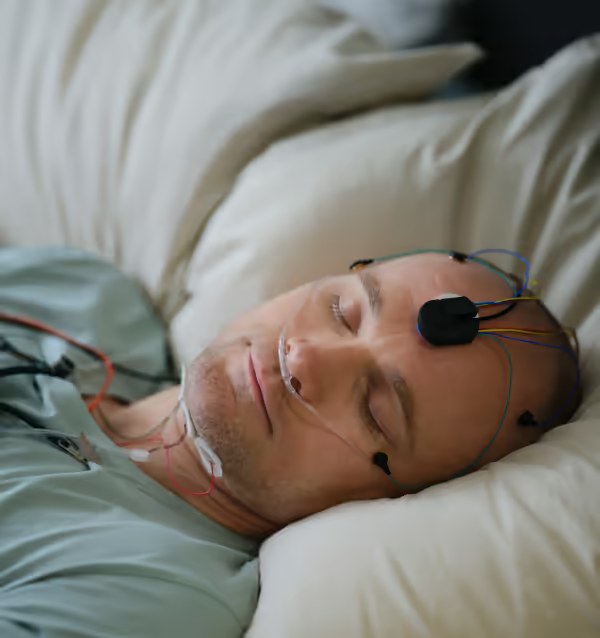
What is a sleep study?
A sleep study is a diagnostic test that records what happens in your body during sleep. It is commonly used to investigate symptoms such as loud snoring, breathing pauses, waking gasping, restless sleep, morning headaches and excessive daytime sleepiness.
Sleep studies can help assess conditions such as obstructive sleep apnoea, periodic limb movement disorder and other sleep-related concerns.
During testing, equipment may record your breathing, oxygen levels, heart rate, body position and movements. In-lab polysomnography also measures brain activity, eye movements and sleep stages.
What is an at-home sleep study?
An at-home sleep study allows you to complete overnight testing in your own bed.
At NBST, you attend our North Lakes or Clayfield clinic to have the monitoring equipment fitted and receive instructions before completing the study at home. You return the equipment to the clinic the following day.
Home sleep studies are commonly used when obstructive sleep apnoea is suspected. Symptoms may include loud snoring, daytime fatigue, morning headaches, restless sleep and night-time teeth grinding.
Sleeping in your usual environment is usually more comfortable for patients, especially those who have family, work or travel commitments that make staying overnight at a clinic difficult.
The main limitation is that home studies can collect fewer signals than an in-lab study, depending on the equipment used. They may not provide the same level of detail about sleep stages, unusual movements or other sleep disorders. Suitability will come down to symptoms, complexity, ability, usability and if your GP or cardiologist have other concerns.
What is an in-lab sleep study?
An in-lab sleep study, or polysomnography (PSG), is completed overnight at a sleep clinic and may be recommended if:
- Your symptoms are more complex
- A previous home sleep study was unclear
- Another sleep disorder is suspected
- You have significant heart, lung or neurological conditions
- Your doctor needs more detailed information about sleep stages or movements
- You need CPAP titration or further treatment assessment
During the study, sensors are placed on your body to record breathing, oxygen levels, heart rhythm, brain activity, eye movements, muscle activity and leg movements. At NBST, in-lab sleep studies are conducted in private rooms at our Clayfield clinic, with monitoring by trained sleep scientists throughout the night and the results reviewed by our Respiratory and Sleep Medicine Specialists.
Which sleep study is better?
Neither an in-lab or at-home sleep study is automatically the right choice for everyone. What is recommended will be based on your symptoms, medical history and the condition being investigated.
If you have symptoms suggesting obstructive sleep apnoea and no significant complicating medical conditions, an at-home sleep study could provide the information needed for diagnosis.
If you have more complex symptoms, other medical conditions or a suspected movement or neurological sleep disorder, an in-lab study will more likely be recommended.

What happens after your sleep study?
After your study, the recorded information is reviewed and interpreted by a Respiratory and Sleep Medicine Specialist. A report is then sent to your GP or referring doctor who will discuss the results with you, including if sleep apnoea or another sleep disorder has been identified.
If sleep apnoea is diagnosed, treatment options can include lifestyle changes, sleep position strategies, CPAP therapy, oral appliance therapy or management of contributing nasal or respiratory conditions.
If your results are normal but symptoms continue, your doctor may recommend further assessment to investigate other possible causes.
FAQs about sleep studies
When to talk to your GP about a sleep study
Sleep problems can affect your concentration, work, driving, mood and daily activities. If you regularly snore, wake gasping, feel sleepy during the day, experience morning headaches or have been told you stop breathing during sleep, speak with your GP about sleep testing.
North Brisbane Sleep & Thoracic provides sleep studies and specialist sleep care for patients across Brisbane's northside, with clinics in North Lakes and Clayfield.
|
North Lakes |
Clayfield |
Call 1300 391 820 or contact our friendly team at North Brisbane Sleep and Thoracic to arrange an appointment.
*This article is for general information and educational purposes only. It is not a substitute for professional medical advice, diagnosis or treatment. Always follow the guidance of your GP, specialist or other qualified health professional regarding any questions about your health.
References
Healthdirect Australia. (2022). Obstructive sleep apnoea (OSA). https://www.healthdirect.gov.au/obstructive-sleep-apnoea
Sleep Health Foundation. (2025). Sleep study. https://www.sleephealthfoundation.org.au/sleep-disorders/sleep-study
